Research Interests
Image credit: James Josephides, Alister Graham.
Prof. Alister Graham’s research in extragalactic astronomy investigates how galaxy morphology, dark matter halos, central massive black holes, nuclear star clusters, and mergers collectively drive galaxy evolution across cosmic time. His work has focussed on the structure and dynamics of galaxies from dwarf systems to massive elliptical galaxies, using observations from major international observatories to study how these components coevolve. His current work focuses on galaxy–black hole coevolution using morphology-dependent scaling relations, with important implications for gravitational-wave astronomy (LISA) and upcoming large surveys such as LSST/Rubin Observatory.
Recent Papers
A selection of recent works spanning galaxy morphology, black hole scaling relations, ultra-diffuse galaxies, little red dots, and implications for gravitational wave forecasts.
- A. Graham 2026, "Galaxy morphology dependent (black hole mass)-(velocity dispersion) relations: implications for gravitational wave forecasts and cosmological simulations", MNRAS, submitted.
- A. Graham 2026, "Clash of the Trident and Tuning Fork: insights from bar and spiral strength in the (massive black hole)-stellar mass diagrams, and the `Triangal' galaxy evolution schema", MNRAS, in press.
- A. Graham et al. 2025, "Dot to dot: high-z little red dots in Mbh–M⋆ diagrams with galaxy-morphology-specific scaling relations and nuclear star clusters", PASA, 42, e068.
- A. Graham 2025, "Re. II. Understanding (IC 3475)-type galaxy, aka ultra-diffuse galaxy, structural scaling relations", PASA, 42, e155.
- A. Graham 2024, "Early-type galaxy speciation: Elliptical (E) and ellicular (ES) galaxies in the Mbh-M*,sph diagram, and the Sérsicification of E galaxy light profiles", MNRAS, 535, 299.
- A. Graham et al. 2024, "Specific star formation rates in the Mbh-M*,sph diagram and the evolutionary pathways of galaxies", MNRAS, 527, 10059.
Galaxy Speciation
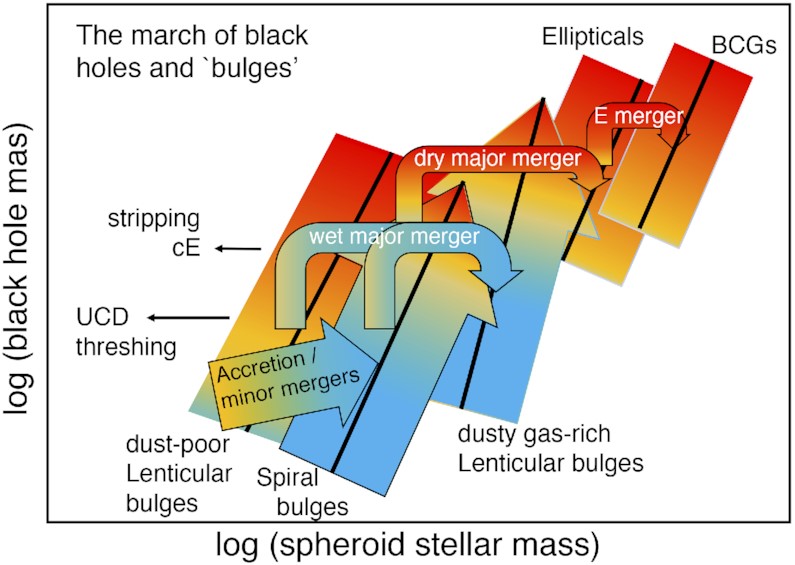
(Galaxy morphology)-aware Mbh – Msph mass scaling relations. The progression
of mass and entropy
(Graham 2023).
Galaxy morphology provides a key window into galaxy assembly history. Giant elliptical galaxies are not simply scaled-up versions of smaller systems, but follow systematic structural trends linked to formation pathways and black hole growth.
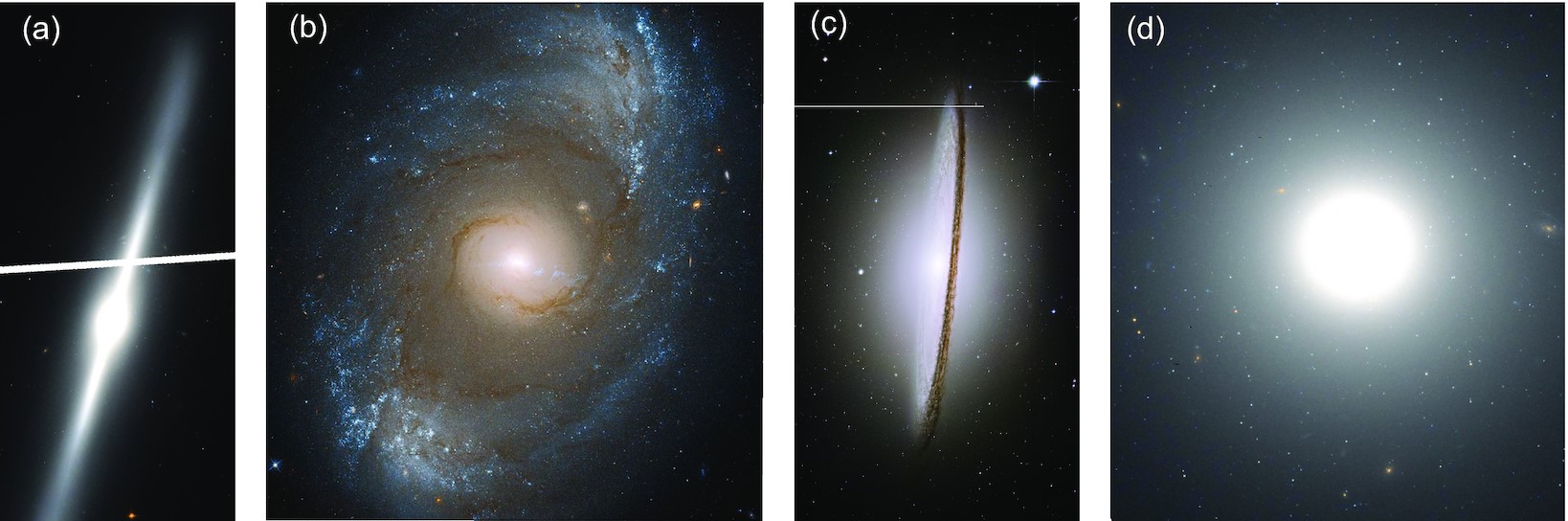
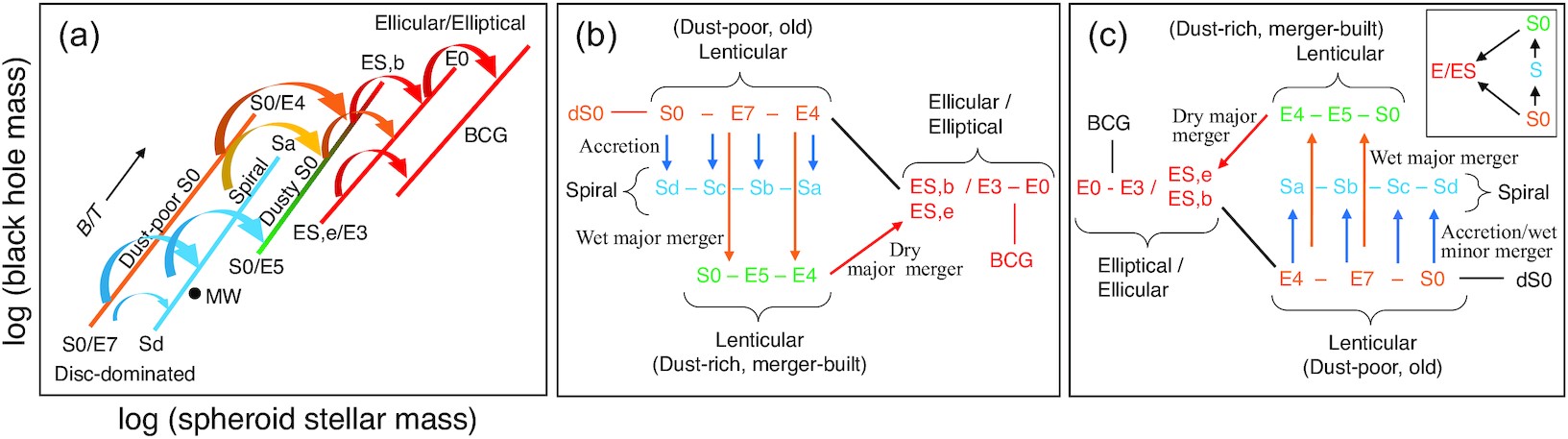
Intergalactic speciation and the `Triangal': A modern view of galaxy evolution extending beyond the classical `Tuning Fork' sequence. Upper panel: (a) Dust-poor lenticular (S0) galaxy NGC 4762, (b) spiral (S) galaxy NGC 4151, Dust-rich S0 galaxy NGC 4594, and (d) elliptical (E) galaxy NGC 1407. Lower panel: The Triangal.
Concepts and Models
- core-Sérsic model
- ellicular galaxies
- galaxy speciation
- Sérsicification
- galforming galaxies
- Triangal framework
- Disc Downsizing sequence
- Dust Attrition sequence
Select discoveries and contributions
- Discovery of the Mnsc – Msph mass scaling relation (cf. the Mbh – Msph relation: Maggorian et al. 1998) linking nuclear star clusters with their host galaxy's spheroid/bulge (Balcells et al. 2003; Graham & Guzmán 2003).
- Discovery of the MBH – Mnuclear star cluster relation, relevant for black hole assembly pathways and gravitational-wave progenitors (Graham & Spitler 2009; Graham 2016).
- Development and discovery of (galaxy morphology)-aware MBH – Msph relations, important for understanding galaxy speciation (Graham 2012; 2023).
- Discovery of the MBH – (galaxy stellar-concentration) relation (Graham et al. 2001).
- Demonstration that ultra-compact dwarf (UCD) galaxies are consistent with stripped galaxy nuclei (Graham 2020).
- Red nuggets at high-redshift are shown to be equivalent to the bulges of redshift-zero lenticular galaxies (Graham et al. 2016).
- core-Sérsic model introduced as a physically motivated surface-brightness profile describing partially depleted galaxy cores formed through black hole scouring during galaxy mergers (Graham et al. 2003).
- Galaxy core depletion from merging black holes is shown to be an order of magnitude smaller than previously thought (Graham 2004).
- Sérsicification: Term coined and illustration of the systematic structural transformation of galaxies toward high-n Sérsic profiles through mergers (Graham 2024).
- Galforming: Term coined for brightest cluster galaxies with heavily eroded low-Sérsic-index spheroids (Graham & Sahu 2023).
- Ellicular galaxies: Term coined for ES galaxies, intermediate between elliptical (E) and lenticular (S0) types (Graham et al. 2017).
- Disc Downsizing sequence and Dust Attrition sequence identified in galaxy evolution (Graham 2026).
- Galaxy Speciation introduced to distinguish between galaxy evolution without a change in galaxy type versus pathways between galaxy types (Graham 2023a, 2023b).
- Development of `curved' (rather than linear) size–mass relations demonstrating continuity between dwarf ellipticals, normal ellipticals, and ultra-diffuse galaxies (Graham & Guzmán 2003; Graham 2019, 2025).
- `Triangal' was introduced to describe a galaxy evolution framework extending beyond the Jeans-Reynolds-Hubble Tuning-Fork classification (Graham 2023).
- Pressure-supported early-type galaxies shown to be much rarer than previously thought (Graham et al. 1998).
Current Research Programs and Collaborations
- Core member of the LISA mission, a space-based gravitational-wave observatory targeting merging supermassive black holes, intermediate-mass black holes, and other sources of gravitatioanl radiation.
- Member of the LSST / Rubin Observatory Galaxy and AGN Science Collaborations.
- Black hole mass measurements using the Keck Observatory.
- Guest Observer programs with the Hubble Space Telescope and the Chandra X-ray Observatory.